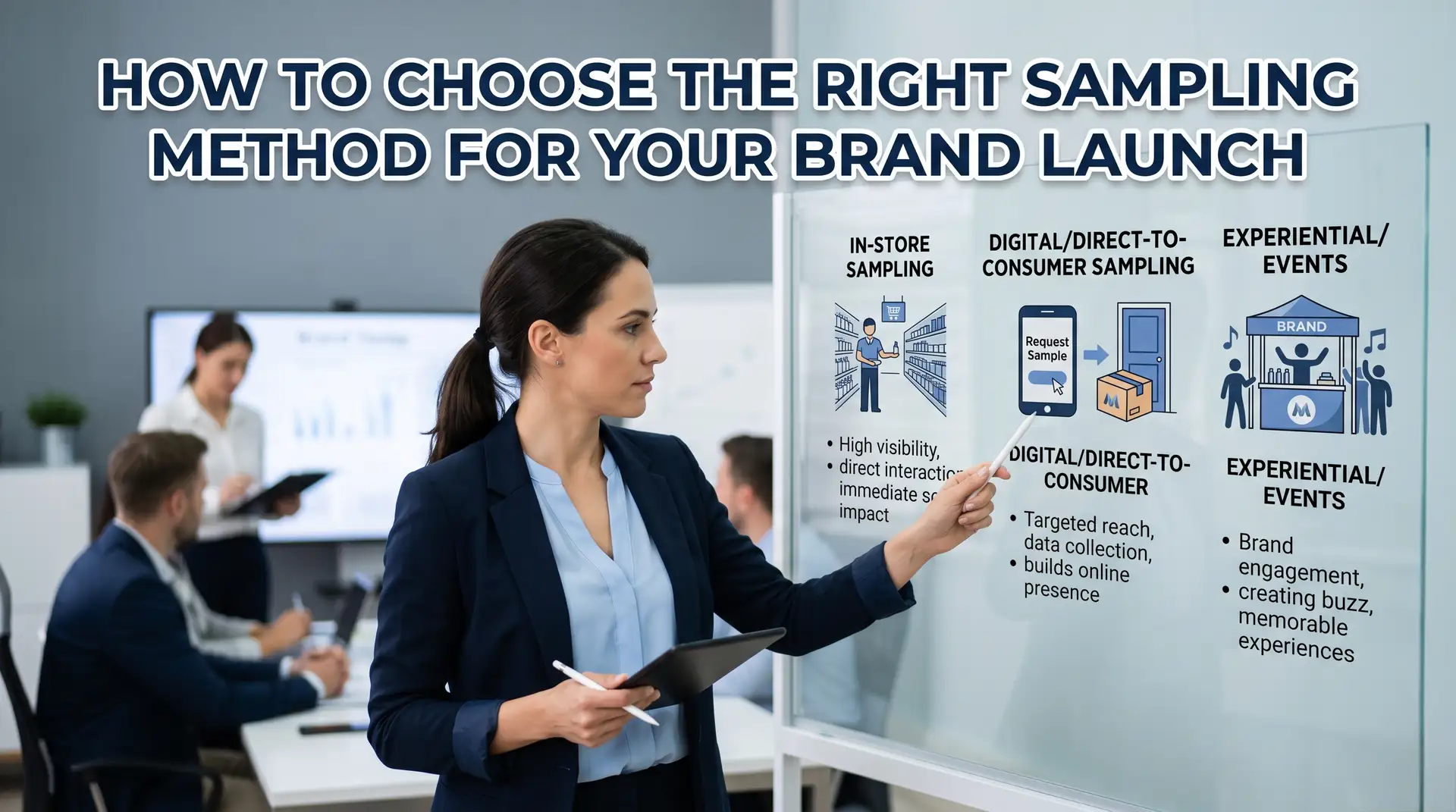
There are ten distinct product sampling methods available to FMCG brands in the Indian market. Most brands default to one — usually Brand-to-Hand at a mall or transport hub — without asking whether that is actually the right method for their product, their consumer, and their objective. It is sometimes not the right method. It is rarely the only one you need.
The Five Questions to Ask First
Before selecting any sampling method, answer five questions about your brand and campaign:
1. Who is your target consumer and where do they spend time? A premium skincare brand targeting SEC A women has a completely different distribution opportunity than a mass-market beverage targeting commuters. The answer shapes every channel decision that follows.
2. Does the product need to be tried at home or can it be experienced on the spot? A snack, a beverage, or a beauty product can be experienced immediately. A laundry detergent, a hair oil, or a home appliance cannot. Products in the second category require in-home delivery sampling — not on-ground activation.
3. What data do you want? If you need first-party consumer data — demographics, purchase intent, channel preference — methods that include structured feedback collection (Social Sampling, Door-to-Door) are essential. If you need volume and speed, Brand-to-Hand works. If you need both, you need two methods in sequence.
4. What is your cost per trial target? Brand-to-Hand at a high-footfall location will give you the lowest cost per trial. Office Sampling and Goody Bag Sampling will give you a higher-quality consumer at a higher cost. Know your economics before you choose your channel.
5. Is this a launch, a relaunch, or a competitive displacement play? A first-to-market launch needs wide reach and rapid awareness. A relaunch needs targeted trial with structured feedback. A competitive displacement campaign needs to intercept consumers at their existing point of purchase — which means In-Store sampling is often the right answer.
The worst brief we receive is: “we want to sample 100,000 units.” The best is: “we want 10,000 qualified household trials in three cities within 60 days, with purchase intent data from every consumer.”
Method Selection by Objective
Maximum reach and rapid awareness: Brand-to-Hand at malls, metro stations, and markets gives you the highest volume of consumer contacts per day. Use this when you need to move fast and wide — a new product launch in a city where your brand has low recall.
Premium-income consumer targeting: Office Sampling in corporate campuses and tech parks reaches SEC A and B consumers at predictable cost with high receptivity. Best for wellness products, premium F&B, and personal care categories where purchasing power is a qualifying criterion.
Household trial with data capture: Social Sampling and Door-to-Door used in combination are the right approach when the product must be used at home and you need structured consumer feedback. The opt-in model ensures the consumer is pre-qualified; the in-home delivery ensures the trial happens in the right context.
Point-of-purchase conversion: In-Store sampling intercepts consumers at the moment of buying decision. This is the most efficient method when your target consumer already uses the retail channel and you need to convert shelf consideration into trial at the shelf.
High-value audience and borrowed trust: Goody Bag Sampling, Student Sampling, and Event Sampling all operate on the principle that context shapes reception. A product placed in a premium event gift bag arrives with an implicit endorsement. A sample distributed at a campus reaches a consumer at the beginning of their category brand relationship.
The Combination Advantage
The most effective sampling campaigns deploy two or three methods in a deliberate sequence. A brand launch might start with Brand-to-Hand to generate rapid awareness and volume trial, layer in Social Sampling to capture household data from a more targeted consumer segment, and close with In-Store activations to convert the now-aware consumer at the point of purchase.
Each phase reinforces the last. The consumer who was sampled on-ground is more likely to convert when they see your product at shelf. The consumer who opted into Social Sampling is the ideal retargeting audience for your digital campaign. The data from all three phases combines into a single picture of your consumer and your market.
What This Means for Your Brief
When you come to us with a campaign, we do not lead with methods. We lead with objectives, consumer profiles, and geographic priorities. The method selection follows from those answers — it is never the starting point. A brand that approaches sampling with the question “how do we distribute 200,000 units?” will get a logistics plan. A brand that asks “how do we convert our target consumer in the 18-month window after this product launches?” will get a campaign.